

Quick Summary – What You’ll Learn in This Post:
- Why calorie counting isn’t always accurate
- How sneaky calories from sauces and snacks add up
- Why quality sleep is crucial for weight loss
- The powerful impact of weight training over cardio alone
- Tips to improve calorie tracking and make smarter food swaps
- The importance of fasting periods vs. constant snacking
- Encouragement to keep going, even when progress feels slow
Let’s talk about something I’ve seen way too often: “I’m counting my calories, I’m exercising, but the scale won’t move!” Sound familiar?
I had a client once—we’ll call him Jay—who came to me weighing about 350 pounds. He was determined. He looked me dead in the eye and said, “I want to get to 190 pounds, and I’m ready to do the work.”
And to be fair—he was putting in effort.
Jay told me he was running on the treadmill 30 minutes a day at 12 mph (serious effort!), and he had started counting his calories, trying to stick to 2,500 calories per day. But weeks in, nothing was changing. The scale wouldn’t budge.
So I started asking questions—digging deeper. And that’s when the red flags started popping up:
🚩 1. He Wasn’t Exercising Smartly
Running at 12 mph sounds impressive, but it’s not sustainable for everyone—especially not long-term. I explained that cardio burns calories during the workout, but weight training boosts your metabolism all day long.
Muscle burns more calories at rest than fat. So, the more muscle you build, the more calories your body naturally burns—even while binge-watching your favorite show. I recommended that if he only had 30 minutes a day, he should split it:
→ 15 minutes of cardio
→ 15 minutes of weight training
This way, he’d get the benefits of both immediate calorie burn and long-term metabolic boost.
🚩 2. He Wasn’t Sleeping Enough
When I asked about his sleep, he chuckled. “I barely get 5 hours,” he said.
Yikes.
Lack of sleep messes with your hormones—especially cortisol, the stress hormone. High cortisol levels can slow down fat loss, increase cravings, and make your body hold on to fat, especially around the belly.
I gave him this challenge:
Aim for at least 8 hours of quality sleep per night.
💤 Sleep Tips I Shared With Him:
- Invest in a good mattress and pillow
- Use blackout curtains to block out light
- Turn off all screens at least 30 minutes before bed
- If you need to pee at night, install red light bulbs in the bathroom (they won’t mess up melatonin like blue/white light)
- Deal with stress before bed—journal, pray, stretch, whatever helps you unwind
- Snoring? Talk to your doctor. You may have sleep apnea and not even know it.
🚩 3. He Wasn’t Counting Calories Accurately
He told me he was using a calorie-counting app. Good start! But then he added, “I had a salad today!”
Sounds great, right?
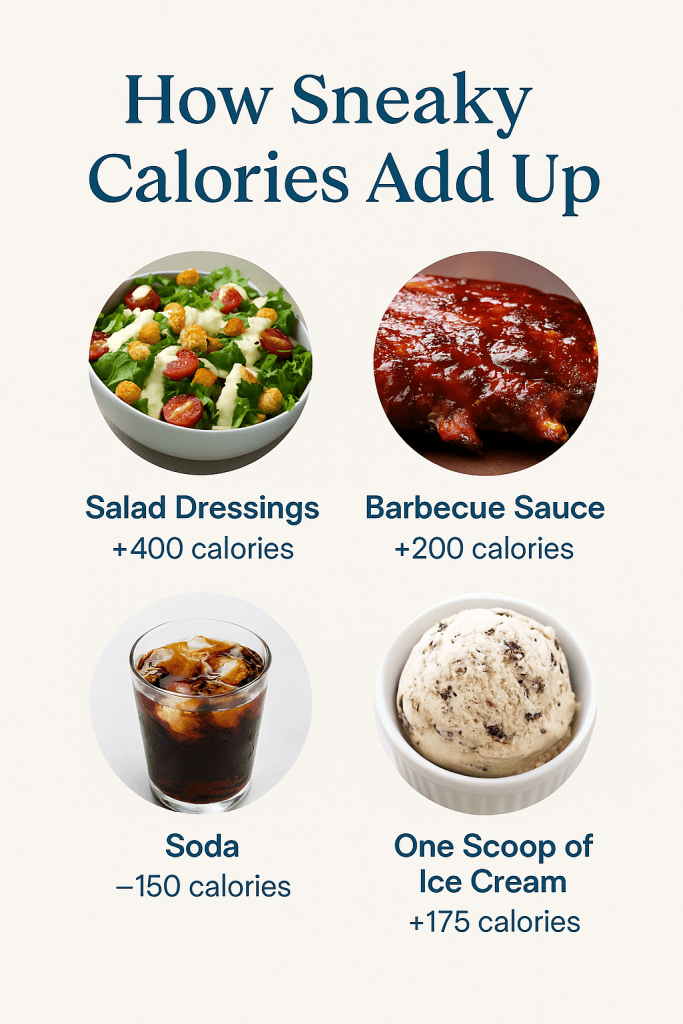
But that salad had a river of ranch dressing, croutons, bacon bits, and sauces. Those toppings can add 400+ hidden calories—easy.
Barbecue sauce on meat? That could sneak in another 200 calories.
One “scoop” of ice cream? Probably more like 1.5 or 2 scoops unless measured precisely.
Solution: Use apps like MyFitnessPal or Cronometer as guides, but don’t trust them blindly.
Read nutrition labels. Weigh your food with a digital scale. Measure dressings and sauces. When in doubt, round up your estimate.
🚩 4. He Was Still Making Unhealthy Choices (Even if “Small”)
He was still:
- Drinking a soda every day
- Snacking on potato chips in the afternoon
- Ending each day with ice cream
Now, I’m not the food police. I believe you can still enjoy your favorite things in a healthy lifestyle—but we have to be realistic when trying to lose weight.
I encouraged Jay to make simple but powerful swaps:
🍟 Potato chips → Air-fried carrot or spinach chips
🍨 Ice cream → No-sugar-added Greek yogurt with frozen berries
🥤 Soda → Homemade lemon-lime soda with sparkling water + stevia
🚩 5. He Was Snacking All. Day. Long.
Lastly, Jay confessed, “I eat a few little snacks here and there… nothing big.”
Here’s the problem: Those tiny snacks add up, and they disrupt your body’s fasting window. Your body needs time to digest, reset hormones like insulin, and tap into fat stores. When you snack all day, your body never gets that break.
Fasting periods are powerful. They allow your body to stop processing food and start burning stored fat. I told Jay:
“Try to give your body at least 4-5 hours between meals, and stop eating a few hours before bed.”
So What Happened?
Jay took the advice seriously.
- He started lifting weights.
- He adjusted his diet.
- He started sleeping more and tracking smarter.
- He cut down on sneaky calories and stopped grazing throughout the day.
One year and three months later… he’s down to 250 pounds.
That’s 100 pounds lost—and gained energy, confidence, and purpose.
Final Thoughts
If you’ve ever said, “I’m doing everything right, but I’m not losing weight,” take a moment to really evaluate.
- Are you sleeping enough?
- Are you tracking accurately?
- Are you letting sauces, snacks, or stress sneak in?
- Are you building muscle?
- Are you giving your body time to rest and reset?
Weight loss is not linear. There will be plateaus. There will be moments of frustration. But I promise you—every effort counts. One step at a time. One better choice at a time.
So don’t give up. Keep learning, keep growing, and keep showing up for yourself.
You’ve got this.
 Lose Weight Rightly